15th
May
2008
Question: I’d like to ask you a question. Recently I ordered garden seeds from a licensed nursery in another state. These seeds came shipped in clear cellophane with no directions or instructions of any kind such as sun, shade, when to plant ,etc, etc. I complained and they said tough - no refunds. What I’d like to know is what is required in packaging to ship seeds across state lines? Don’t packets have to contain certain specific information? How do I file a complaint against this dealer? I’d appreciate any help you could offer. Bob - new castle, indiana
Answer: I believe there are minimum standards like name of plant, year it was packaged. If you would like to pursue this further I wood contact the USDA’s (United State’s Department of Agriculture’s) Seed Regulatory and Testing Branch:
Write to: Seed Regulatory and Testing Branch
801 Summit Crossing Place, Suite C
Gastonia, North Carolina 28054-2193
email: seed.ams@usda.gov
or call: Phone: 704-810-8870
FAX: 704-852-4189 (Lab), 4109(Chief)
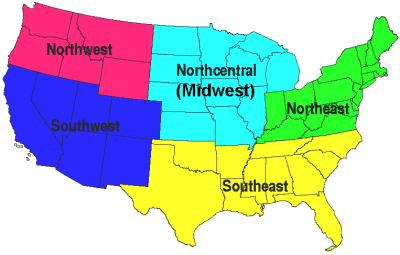
posted in Northcentral (Midwest) U.S. Gardeners |
2nd
May
2008
Question: I’m trying to identify a flower. We live in Athens, Georgia (she’s about 20 minutes outside of Athens.) and this is something that has been in my friends yard since she moved into the house, and until this year she’s been pulling them up because she thought they were clover. Looks like 2 flowers put together, totally different parts of them. Front part is white w/yellow stamens and back part is purple and looks almost lily-ish.She hadn’t gotten to it this year, and they bloomed. Here’s the link for the pictures… Thanks, Wendy R.
Answer: That is a type of columbine (Aquilegia) a garden perennial. The darker colored part are the sepals and the white the petals. There are many types of columbines. Some produce flowers in a single color or like the one your friend has are bicolored.
posted in Southeast U.S. Gardeners |
11th
February
2008
Q. Interested in advice on planting mophead hydrangea in my zone 6 location. The area I am planting receives sun from 12N on. Soil is clay & will slopes away from plants. I am asking before I buy as I need approximately 15 bushes to fill in space & don’t want to make the investment if it is a losing battle. Please advise, if possible. Tonya Amber - Vanderbilt, Pa
A. The mopheads fall under Hydrangea macrophylla and from what I can tell your location is just a little too cold for regular blooming as the plants may freeze to the ground in many years in the west of Pennsylvania. This would kill off the flower buds. You would have beautiful plants but not any blooms. If you are interested in having a hydrangea you may want to try the Peegee Hydrangea (H. paniculata ‘Grandiflora’) which would handle your winters a little better. Be sure to add some organic matter (like compost) to the soil before planting to help enrich and aerate your clay soil.
posted in Northeast U.S. Gardeners |
7th
January
2008
Q. Happy New Year,I have a potted Ficus tree outdoors. It is extremely healthy but I now see that the roots have gone through the pot and into the ground.Can I cut the roots off at the bottom of the pot? or will this kill the tree? Sandy in Florida
A. Unless the potted ficus tree has been rooting in the ground for several seasons I believe that there will be no long term adverse effects to cutting off the roots if you need to move it. But short term ficus can react to being moved - especially when the lighting changes dramatically. It reacts by dropping a few to many leaves.
posted in Southeast U.S. Gardeners |
15th
November
2007
Q. This summer I made a purchase of this plant at the local Lowe’s. The
plant is turning yellow and then to dead leaves. What do I do, cut it
down to ground level? Cover it up with mulch? Can’t find any
directions for winterizing it here in the low country. I think we
are 8B zone. Thank you for any help you can share with me. Jackie Dittimer - Charleston, SC
A. Curcuma is a ginger family plant that is normally grown in a greenhouse when temperatures fall below 64 degrees F. according to the American Horticulture Society’s Encyclopedia of garden plants. They grow in frost free areas where they go dormant due to drought and not cold. So you may try digging it and potting it up and keeping it in a garage with the soil kept on the dry side all winter and then replant in spring. You local Master Gardeners may also have first hand experience with this plant.
posted in Southeast U.S. Gardeners |
15th
November
2007
Q. This year I had lots of moss in my flower garden. Although I have had
patches of moss on other places before, I don’t remember much in my
garden areas. It’s gone now, having had my bed cleaned up for the
winter, but how do I keep it from coming back or killing it if it
does, without hurting my flowers? Sure miss your column in the Tacoma News Tribune.
The new format is not nearly as relevant. Betty Garrison - Tacoma, WA
A. The best way to get rid of moss is to do the opposite of if you wanted it to grow. It prefers a firm acidic substrate (it doesn’t have roots but does have root like structures that help keep it in place) plenty of moisture as well as indirect sunlight (thus why it loves the north side of roofs better than southern side). So if you have poor drainage improve it by adding organic matter to the soil and working it in. cultivate the surface of the soil each month (this also helps control weeds) with a hoe or similar cultivating tool. Check the pH of the soil. Unless you are growing acid loving plants like rhodies and azaleas add lime to bring the pH up just below neutral (6.8 -6.9). And if possible prune the exising plants to allow more light to the soil surface. You can also help the process by using a natural moss control product like Moss and Algae Killer. - HG
posted in Northwest U.S. Gardeners |
15th
November
2007
Q. We have some questions regarding our Mass Cane plant. We’ve had this
plant for 6 years but recently it started growing this long flower
like substance. Is it normal for this plants to grow flowers? Also,
it has a very strong scent. We are just concerned that it may be
toxic in any way. We have a baby in the house and a small dog. Please
look at the pictures I am sending you and please let me know as soon
as possible.
http://i23.photobucket.com/albums/b396/2pwrful/Pic002.jpg
http://i23.photobucket.com/albums/b396/2pwrful/Pic001.jpg
Thank you,We have some questions regarding our Mass Cane plant. We’ve had this
plant for 6 years but recently it started growing this long flower
like substance. Is it normal for this plants to grow flowers? Also,
it has a very strong scent. We are just concerned that it may be
toxic in any way. We have a baby in the house and a small dog. Please
look at the pictures I am sending you and please let me know as soon
as possible.
http://i23.photobucket.com/albums/b396/2pwrful/Pic002.jpg
http://i23.photobucket.com/albums/b396/2pwrful/Pic001.jpg
Thank you,
Steve Slaughter
A. Mass Cane or Corn Plant (Dracaena fragrans cv. massangeana) is considered not toxic to humans by most authorities. The fact that it is flowering is uncommon in most home settings, but it does happen for many people especially when they manage to keep the plant form many years (for many the roots rot due to over-watering especially in the winter). The plants will flower when they mature so longevity is key as are conditions that are similar to their native habitat in East Africa.
posted in Gardening Q & A |
5th
December
2006
Q. I received a rose bush for Mother’s Day and kept it in a clay pot on the deck because it is the only sunny spot. Will it survive the winter in a clay pot. Any special precautions? Also, it has had black leaf problem. Will that kill it this winter? Thanks. Maureen - Holmdel NJ
A. It depends how close the pot is to the house. There is always a chance that a clay pot will break if there are freezes and thaws. Unless the clay pot is sealed the trapped water in the clay pot expands as it freezes and can crack the pot. Also see if you can find the USDA hardiness zone of your rose. It may be printed on the label that came with the plant. You can leave plants in containers safely if they are rated for two zones lower than your zone. I would guess you are at a zone 7 (Having grown up in NJ I know you are near the shore). That means a plant rated to zone 5 could be grown in a pot. The alternative is to find a sunny location in the yard and sink the pot in a hole until spring. The black spot disease you have on the roses won’t be active during the winter but the overwintering spores may attack your rose again in the spring. Once the plant is actively growing again can use organic neem oil to control the blackspot.
posted in Northeast U.S. Gardeners |
29th
November
2006
Q. My neighbor has a lovely red Norway maple. The city inspector wants to cut it down saying it has wilt infestation. To me it looks very healthy. It is about six or seven years old. How does the inspector determine this kind of disease and how can get evidence? I do not want the tree cut if it has a chance to survive. Isabella Kates - Ontario, Canada
A. They have probably diagnosed Verticillium Wilt. Usually you see outward signs of stress first, like reduced leaf size or wilting of leaves when there is no drought. The strongest indicator is then looking in at the wood, which usually becomes discolored from the infection. Your own University of Guelph has a very nice document http://www.uoguelph.ca/pdc/Factsheets/PDFs/007VerticilliumMaple.pdf on the disease which should help you solve this yourself. At least you will be able to converse with the city inspector and have some knowledge of what he is talking about.
posted in Outside U.S. Gardeners |
25th
November
2006
Q. It’s my first winter in my new “established” house. Lot’s of free standing bushes which I know all flower in different times of the summer, don’t know what they are but they have become overgrown and I have no idea when to prune them or how much. There are forsythia, taller then a person and the two other major bush growths are 15 to 20 feet high and I would like to get them down to about 5 ft or so any suggestions, based on the info I have provided? Thanks Sandy - Vernon CT
Without knowing what the other species of shrubs are it is difficult to tell you how to prune them and what type of pruning (e.g. drastic) they will tolerate. Many shrubs have their own genetic predispositions. I can say that if they are flowering shrubs and you do not wish to loose a season of blooms you will want to prune early blooming shrubs immediately after they bloom since they bloom on old wood where flower buds form. Later blooming shrubs have a larger pruning period, which includes the dormant season, since the flowers will develop on new season’s growth. Your forsythia will take some heavy but judicious pruning. It flower buds grow on old season growth so take that into consideration when pruning. I would suggest either finding a book on pruning shrubs or checking out the University of Connecticut’s Home and Garden Education Center website: http://www.ladybug.uconn.edu/ for more information.
posted in Northeast U.S. Gardeners |